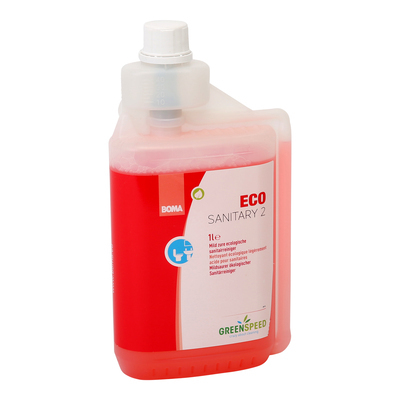
San Daily - 1 l
Highly concentrated sanitary cleaner for daily use.
- For acid-resistant materials.
- Mildly acidic formula for active limescale removal.
- No need to rinse.
- Lemon fragrance.
Eco Score
The BOMA ECO-SCORE is its own scoring system that rewards products with certificates, made from recycled material, designed for the circular economy. On the other hand, dangerous, disposable or harmful products are punished. A+ products are the best available products and E-products are products to be avoided.
Recycled
This product is made partly or completely from recycled material.
EU Ecolabel
The EU Ecolabel is the only uniform environmental characteristic of the European Union. It is only awarded to environmentally friendly and profitable products. The evaluation is based on life cycle analysis (from raw material extraction to manufacturing, use phase and waste processing).
Cradle to Cradle
Cradle to Cradle is a concept that is based on the idea "waste is food " (waste equals food) where materials and substances from the products and materials at the end of their life must be able to be reused without loss of quality in an infinite loop.
Product specifications
| Article: | 283230 |
| Unit: | bottle |
| Quantity per packing: | 12 bottles per box |
| Quantity per pallet: | 36 boxes per (432 bottles) |
| Length: | 9 cm |
| Width: | 5.5 cm |
| Height: | 25.5 cm |
| Gross weight: | 1150 g |
| Barcode EAN: | 5407003310214 |
| Cleaning Power: | mild |
| pH value: | 4 |
| Suited for: |
|
Instruction manual
The exact dose depends on the level of soiling, the hardness of the water and the use of microfibre technology.
Hazard statements:
H318 Eye Dam. 1: Causes serious eye damage.
Related Articles
Accessory
Eco Score
The BOMA ECO-SCORE is its own scoring system that rewards products with certificates, made from recycled material, designed for the circular economy. On the other hand, dangerous, disposable or harmful products are punished. A+ products are the best available products and E-products are products to be avoided.
Eco Score
The BOMA ECO-SCORE is its own scoring system that rewards products with certificates, made from recycled material, designed for the circular economy. On the other hand, dangerous, disposable or harmful products are punished. A+ products are the best available products and E-products are products to be avoided.
Eco Score
The BOMA ECO-SCORE is its own scoring system that rewards products with certificates, made from recycled material, designed for the circular economy. On the other hand, dangerous, disposable or harmful products are punished. A+ products are the best available products and E-products are products to be avoided.
Eco Score
The BOMA ECO-SCORE is its own scoring system that rewards products with certificates, made from recycled material, designed for the circular economy. On the other hand, dangerous, disposable or harmful products are punished. A+ products are the best available products and E-products are products to be avoided.
Eco Score
The BOMA ECO-SCORE is its own scoring system that rewards products with certificates, made from recycled material, designed for the circular economy. On the other hand, dangerous, disposable or harmful products are punished. A+ products are the best available products and E-products are products to be avoided.
Suited for
Eco Score
The BOMA ECO-SCORE is its own scoring system that rewards products with certificates, made from recycled material, designed for the circular economy. On the other hand, dangerous, disposable or harmful products are punished. A+ products are the best available products and E-products are products to be avoided.
Alternative
Eco Score
The BOMA ECO-SCORE is its own scoring system that rewards products with certificates, made from recycled material, designed for the circular economy. On the other hand, dangerous, disposable or harmful products are punished. A+ products are the best available products and E-products are products to be avoided.
EU Ecolabel
The EU Ecolabel is the only uniform environmental characteristic of the European Union. It is only awarded to environmentally friendly and profitable products. The evaluation is based on life cycle analysis (from raw material extraction to manufacturing, use phase and waste processing).
Eco Score
The BOMA ECO-SCORE is its own scoring system that rewards products with certificates, made from recycled material, designed for the circular economy. On the other hand, dangerous, disposable or harmful products are punished. A+ products are the best available products and E-products are products to be avoided.
EU Ecolabel
The EU Ecolabel is the only uniform environmental characteristic of the European Union. It is only awarded to environmentally friendly and profitable products. The evaluation is based on life cycle analysis (from raw material extraction to manufacturing, use phase and waste processing).
Cradle to Cradle
Cradle to Cradle is a concept that is based on the idea "waste is food " (waste equals food) where materials and substances from the products and materials at the end of their life must be able to be reused without loss of quality in an infinite loop.
- Certification
-
-
What does Cradle to Cradle mean?
Cradle to Cradle is a quality model on which products are assessed based on their positive contribution to people and the environment. The best known and key design principle of Cradle to Cradle is 'waste equals food', supported by two key philosophies: 'use of renewable energy' and 'celebrate diversity'.
Products are assessed in five categories:
- Healthy materials: The safety of a product is assessed based on the materials used in the product. A check is carried out on whether any prohibited chemical substances have been used.
- Recycling: Products are assessed on the reuse of materials, calculated with regard to the recyclability and renewability of the materials.
- Renewable energy: Encouraging the use of more renewable energy in manufacturing the product and that greenhouse gas emissions are restricted.
- Sustainable water policy: Companies have to demonstrate that they are using water in a responsible and efficient manner. The objective is to guide companies towards a sustainable water policy resulting in a production process that has a positive impact on water sources.
- Social fairness: Safeguarding the interests of all parties involved in the business, such as the employees, customers, the community and the environment
Cradle to Cradle, certificate, certification
-
What does the EU Ecolabel stand for?
The EU Ecolabel or "the Flower" (named after the logo with the flower and the stars) is the official European environmental label recognised by all countries of the European Union and by Norway, Liechtenstein and Iceland. It indicates which products are better for the environment without compromising on quality. The EU Ecolabel is reliable and offers certainty: all products and services bearing the label have been verified by independent bodies for compliance with the strict environmental criteria.
One of the strengths of the EU Ecolabel is that it takes into account the entire life cycle of a product, from extraction of the raw materials to the moment the product is discarded as waste.
For each product group, it is examined within which phase the impact on the environment is greatest. Criteria are then drawn up to reduce this impact. For a hand dishwashing detergent, for example, the impact is great when it ends up in the water; for a printer, it is the paper and energy consumption. That is why the criteria vary greatly for each product group. Products that reduce the impact on the environment throughout their life cycle are rewarded.
EU Ecolabel, certificate, certification
-
- Packaging
-
-
What materials are used to make the bottles and are they recyclable?
The Greenspeed 1 l, 750 ml and 500 ml bottles are made of a combination of 25% recycled plastic from consumers (PCR: Post Consumer Recycled) and 75 % PE (plant plastic) based on sugar cane instead of oil. They are perfectly reusable and recyclable.
bottle, packaging, can, plastic, recyclable, recycled, plantplastic, plantastic
-
What is Plantplastic and can the packaging be composted?
Plantplastic is a vegetable-based polyethylene (PE) plastic that we use in our bottles. Our bottles contain a mix of Plantplastic and recycled plastic from consumers (PCR: Post Consumer Recycled). By using Plantplastic and recycled plastic, we greatly reduce the environmental impact of our packaging. Thanks to Plantplastic, we can also use renewable materials, such as sugar cane instead of oil. The bottles are 100% recyclable, but CANNOT be composted because they are still plastic.
Plantplastic, Plantastic, sugar cane, compostable, packaging
-